Handcrafted in Tahoe
Every part of the build — shape, base, sidewall, edges, core, topsheet — is done by hand in my Kings Beach workshop. No shortcuts, no outsourcing. Here's exactly how each board comes together.


Shape
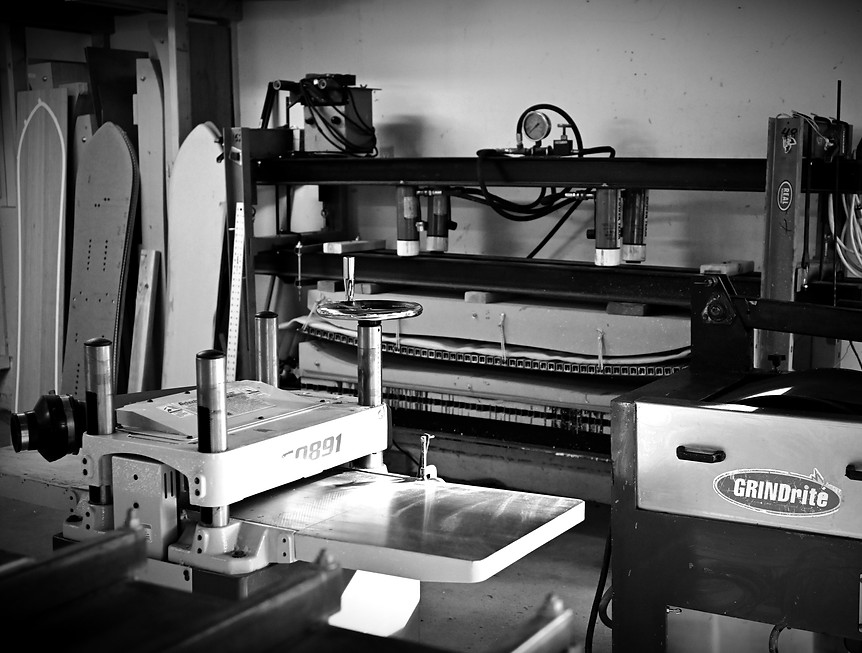
Except for the sidecut, every part of the form is laid out by hand using hand tools. Hand cut with saws and sanded by hand to create the template for the outline of the board. The sidecut is made with CNC for precision.
Base
I use Durasurf 2001 and 4001 premium sintered base. Never die cut. I believe the base is purely functional and should be completely continuous. Base material adds strength, stiffness, and pop to the board. Any discontinuities negatively effect these properties and also give the board additional points of failure. I don't compromise my base with die cuts.

Sidewall
My sidewalls are continuous poured premium urethane cured in a pressure chamber. I use Task21, which is the highest quality product on the market. This product requires either sealing the sidewall trench with epoxy (reduces pores) or the use of a pressure chamber (eliminates pores). Using a pressure chamber eliminates the layer of epoxy between the sidewall and core. My sidewalls are able to be poured directly into the core, penetrating before curing and creating a much stronger bond with the core.
.jpg)

Edges
I hand form the edges. I use 48HRC hardened edges vs. 40HRC for most factory boards. Using hardened steel edges means stronger edges that can be tuned sharper and will keep that sharpness longer. McTernan snowboards all have a full edge wrap. Even the swallowtails.

Core
For my cores I use vertical grain solid bamboo, red cedar, poplar, or a mix of the the 3 materials. Bamboo provides amazing dampening while still remaining lively for a flowy surfy experience. Poplar is strong for the weight but not as strong as bamboo. I'll mix red cedar in to lighten up the core as it's the lightest of the 3. Solid bamboo is my personal favorite but is a little heavy. Whichever material I use is continuous nose to tail. I don't use finger jointed material ever.
Topsheet
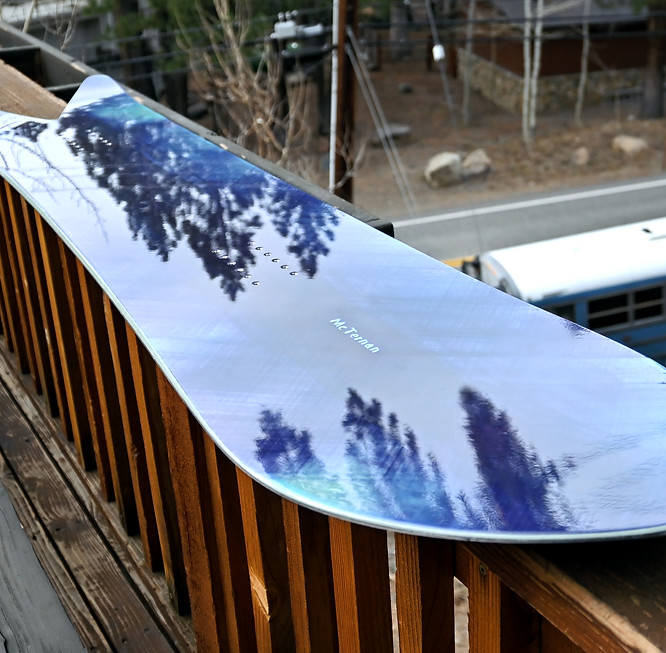
For my pigmented resin boards (no topsheet) I use a 4oz surfboard fiberglass veil over vectorply biaxial or triaxial glass. After pressing, I sand for adhesion, do an epoxy hotcoat, sand smooth, and finally apply a 4-coat glossy automotive urethane clear coat. I also use a real bamboo veneer topsheet. I apply the same 4 coats of automotive urethane to my bamboo topsheets. These methods are significantly more labor intensive, but the finish is more beautiful and repairable than a conventional nylon topsheet.